
 EN



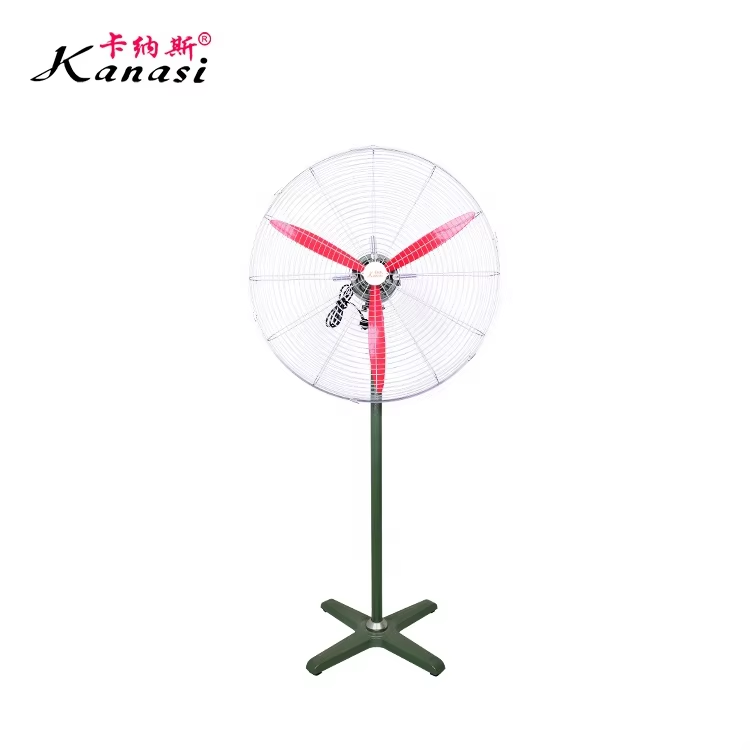
Air that stagnates at floor level rarely gets fixed by a ceiling unit. A heavy duty industrial floor fan attacks the problem at its source, pushing large volumes of air across docks, aisles, and work zones where heat, moisture, and fumes gather. The B293 from Kanasi, a Shunde-based manufacturer building fans since 2007 across an 80,000 m² plant, was engineered for that role. The sections below cover placement, construction, selection, and upkeep.
Where Floor-Level Airflow Wins
Heavy Duty Industrial Floor Fan B293 in a US Logistics Warehouse
A US logistics operator faced hot, stale loading docks: forklift exhaust settled at floor level, inbound pallets arrived damp, and ceiling mixers stirred only the upper air. Kanasi supplied B293 units, each a heavy duty industrial floor fan, placed at dock doors and aisle ends with heads angled across pallet zones. Supervisors reported cooler dock areas through summer peaks, faster drying of washed surfaces, and fewer heat complaints. Kanasi ships every unit from in-house lines under a quality supervision system holding a 98% pass rate.
Floor positioning pays off beyond warehouses. Spot cooling aims air at single workstations — packing benches and welding cells — without chilling an entire hall, and directed airflow shortens drying after washdowns. Near welding benches, ground-level fans help dilute fumes that sink below the reach of overhead extraction, supporting ventilation duties expected under OSHA 29 CFR 1910. Gyms and event halls rely on the same drum fan format for air circulation.
Why Cheap Units Fail: Motors, Blades, and Tip-Overs
Cheap floor fans fail in predictable ways. Motors wound with aluminum wire overheat, and without thermal protection the insulation cooks until the winding shorts. Plastic blades crack under impact and heat, unbalancing the rotor until vibration destroys bearings. Light bases tip when clipped by forklifts. A heavy duty industrial floor fan is engineered against each failure mode from the start.
Dust is the quieter killer. Warehouse ventilation drives constant particulate past any floor-level unit, and open bearings gum up until they seize. Sealed bearings keep contamination out of the race, which matters more at ground level.
Choosing a Heavy Duty Industrial Floor Fan for Daily Duty
Copper Motor Windings, Thermal Overload Protection, and Sealed Bearings
Motor and bearing design decide lifespan. Full copper motor windings handle heat and continuous duty better than thin aluminum, while built-in thermal overload protection cuts power before heat damages the winding. Combined with sealed bearings, the drivetrain holds rated performance. Construction follows ANSI/UL 507, and Kanasi winds motors and assembles units on in-house lines, keeping winding quality, rotor balance, and final testing under one supervision system.
Blade material shapes durability and aerodynamics. Steel blades hold pitch and balance where plastic warps and cracks; for a heavy duty industrial floor fan, steel is the standard choice. The head mounts in a tilt yoke that locks firmly, letting airflow sweep from floor level toward mezzanines. For corridors or confined spaces, the drum-style head accepts duct connections, becoming a flexible air mover.
Sizing by CFM Airflow, Noise, and Maintenance
Size by airflow, not price. Ratings measured to ISO 5801 or ANSI/AMCA 210 give comparable CFM airflow figures; a dock or gym floor needs a strong throw, while one bench needs far less. Match diameter and speed to the zone, and check the decibel specification for units running all shift near workstations. For a heavy duty industrial floor fan, ask suppliers for test-standard numbers rather than catalog claims.
Heavy Duty Industrial Floor Fan Care and Safety
Pre-Purchase Safety Checks
Before purchase, check the blade guard spacing so fingers cannot reach the blades, confirm the grille mounts solidly, and test tip resistance with a low center of gravity.
Routine Maintenance Schedule
After installation, wipe the guard monthly, check yoke locks and fasteners quarterly, listen for bearing noise, and keep inlets clear of dust. Routine care protects a heavy duty industrial floor fan meant to run for years. The frequently asked questions below address common concerns.
Frequently Asked Questions
What makes a heavy duty industrial floor fan different from a household model?
Continuous-duty motors, all-metal construction, and safety hardware separate the two classes. A household fan is rated for intermittent room use; an industrial unit carries copper windings, thermal protection, sealed bearings, a steel blade guard, and a low base. Construction is defined by standards such as ANSI/UL 507 and tested airflow.
How much airflow does a warehouse zone need?
It depends on the task. General movement across docks and aisles works with wide-throw units positioned to sweep the zone; spot cooling at a bench needs less volume; drying needs high velocity close to the surface. Compare ratings measured to ISO 5801 or ANSI/AMCA 210, match throw distance to the space, and confirm the noise level suits nearby work.
Can this floor unit connect to ducting?
Yes. The drum-style head accepts duct connections, extending one unit into corridors, mezzanines, or confined spaces where direct placement is impractical. Keep runs short and smooth, because every bend and meter of duct reduces delivered airflow. For welding fume extraction, a ducted floor unit supplements — but never replaces — a designed local exhaust system.
Where should a floor fan be placed for drying tasks?
Angle the head low and aim across the wet surface so air travels the full length of the area and carries moisture away. Work from the far end toward the exit, keep the unit on stable ground outside the wet zone, and use the tilt yoke to adjust the stream as surfaces dry.
Do metal blades really outlast plastic ones?
In industrial service, generally yes. Steel resists impact from falling tools, tolerates heat near machinery, and holds pitch where plastic deforms and eventually cracks, which unbalances the rotor. The trade-off is weight, so yoke and base construction must be engineered for it. Inspect blades during routine cleaning and replace the unit once cracks or bends appear.