
 EN



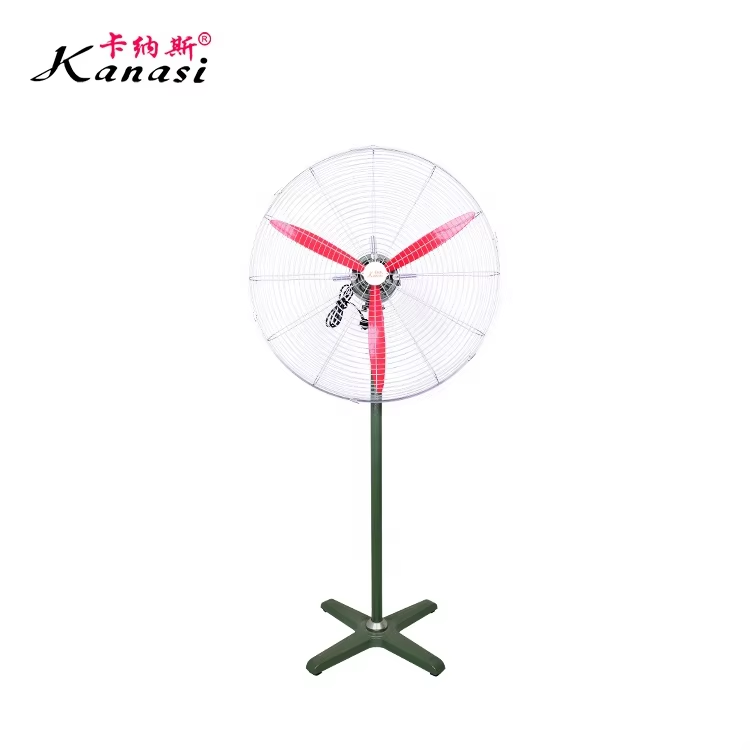
A warehouse with a dozen cooling fans presents a daily chore: walking the aisles to adjust each unit by hand. An industrial fan remote control setup like the one built into the B361 removes that chore, letting staff adjust speed, oscillation and timing from a handheld transmitter. This guide explains the technology behind such systems, a real deployment, and what to check before ordering.
How Industrial Fan Remote Control Systems Are Engineered
Why Radio Frequency Beats Infrared in Factory Conditions
Factory aisles block line-of-sight, which is why infrared remotes from household fans fail here. Radio frequency signals pass through racking, pallets and even concrete walls, so operators adjust equipment without aiming anything. The B361 transmitter and receiver use coded pairing: each remote talks only to fans registered to its code, which prevents one adjustment from rippling across a whole building. That separation is the foundation of dependable industrial fan remote control operation in busy facilities.
Inside the Receiver: Signal Processing and Circuit Protection
The receiver sits inside the fan housing, where vibration, dust and heat never stop. Its control board filters incoming signals, ignores noise from forklift radios and welding equipment, and drives the speed regulator only when a valid command arrives. Housing seals are rated under IEC 60529, the standard used for ingress protection against dust and moisture. Should the circuit overheat or the motor stall, thermal protection disconnects power before damage spreads — engineering that separates industrial fan remote control hardware from consumer gadgets.
Field Experience: Group Control in a Rotterdam Distribution Center
The Problem: Twelve Fans, Twelve Conflicting Remotes
An operations supervisor at a distribution center near Rotterdam managed twelve pedestal fans across two sorting halls. The original units used identical fixed-frequency remotes, so one button press sometimes triggered five fans at once, and afternoon heat meant constant walking between aisles. Staff wasted time, airflow settings drifted, and energy bills crept upward because fans ran at full speed when half speed was enough. The center shortlisted an industrial fan remote control upgrade with grouping capability.
Deployment and Measured Results
Eight B361 units replaced the oldest fans, each receiver paired into two groups matching the hall layout. The supervisor now sets morning and afternoon profiles from a single transmitter: higher speeds during peak sorting, lower speeds plus a shutdown timer for breaks. Interference complaints disappeared because pairing codes isolated each group. The team estimates ten to fifteen minutes of routine adjusting saved per shift, and energy use fell modestly since fans no longer ran flat out. Airflow figures quoted for the B361 follow AMCA test methods, and ventilation rates were checked against ASHRAE 62.1 guidance for warehouses.
Buying, Installing and Maintaining Remote-Controlled Fans
Buyer Checklist Before Ordering
Teams comparing industrial fan remote control products should verify four points. Confirm the pairing method, since fixed codes invite cross-talk between units. Check receiver housing ingress protection, especially in dusty or humid buildings. Review the range specification; large halls need reliable transmission across thirty meters or more. Finally, confirm speed memory, so a fan restarts at its previous setting after a power cut instead of surprising the crew.
Pairing, Setup and Electrical Safety
Pair the transmitter before mounting: register each receiver to its group, test every command, then secure the fan. Wire connections belong to a qualified electrician, and the receiver enclosure must stay closed to preserve its ingress rating. Label remotes by zone so new staff learn the layout quickly, and keep spare batteries in the supervisor's office rather than scattered across the floor.
The B361 demonstrates how industrial fan remote control engineering pays off in daily warehouse work: coded pairing prevents cross-talk, sealed electronics survive hostile conditions, and group control turns a dozen adjustments into a few button presses. Buyers who check pairing, protection ratings and range before ordering avoid most problems this technology can cause.
Frequently Asked Questions
What is RF pairing and why does it matter?
Pairing registers a transmitter's unique code inside each receiver, so commands reach only the intended fans. Without pairing, one remote can trigger every compatible unit within range, which becomes chaos in a building with a dozen fans. Coded grouping lets facilities split equipment into zones and adjust each zone independently from one transmitter.
How far can the signal travel reliably?
Inside typical warehouse buildings, expect reliable transmission across tens of meters, though steel racking and dense stock can shorten the effective range. Test coverage during setup by walking the aisles with the transmitter and marking dead spots. If a far corner drops commands, add a repeater-compatible receiver or assign a second transmitter to that zone.
Can one remote operate fans in different halls?
Yes, through grouping. During pairing, assign each receiver to a group, and the transmitter then addresses one group or several at a time. A supervisor can raise speeds in a busy hall while leaving another unchanged. The arrangement keeps control convenient without letting one command sweep across equipment that operators set deliberately.
Do remote control fans use more electricity?
No. The receiver draws a small standby current, measured in fractions of a watt, which is negligible next to the motor. Remote operation often reduces consumption because staff adjust speed to match conditions instead of leaving fans at maximum all day. Timer functions add further savings by shutting units down during breaks and after shifts.
Why does an industrial fan remote control receiver need ingress protection?
Because the electronics live inside a housing that faces dust, moisture and heat around the clock. An enclosure rated under IEC 60529 keeps particles and water away from the control board, protecting the circuits that decode commands and drive the motor. Sealed receivers keep industrial fan remote control systems dependable where a consumer unit would corrode or short within months.